


In education today, schools must be prepared to provide education to all students, no matter what disabilities, physical, mental or emotional, interrupt a student’s access to said education.
To meet the needs of all students, special types of documentation have been created to assist staff in understanding individual student’s certain needs to access education. This documentation comes in the form of Individualized Education Programs (IEPs) and Section 504 plans.
These plans are legal documents that have the goal of providing all students with fair access to public education. When created, staff are given the knowledge on how to best support students in their development.
What are IEPs and 504 plans?
504 plans come from Chapter 15-PA/Section 504 of the Rehabilitation Act of 1973. These provide accommodations, either for temporary or permanent causes, to students in order to provide them equal access to education. IEPs come from the Individuals with Disabilities Education Act, which is an extension of the Americans with Disabilities Act. IEPs differ from 504 plans because they provide a specially designed, or modified, curriculum. The National Education Association (NEA) describes when to seek either form of documentation.
“As you think about a student who is not progressing as expected, consider referral for a 504 Plan when the student does not require specialized instruction but does need the assurance of equal access to public education; consider referral for a special education evaluation under IDEA and the creation of an IEP when the student requires specialized instruction to have access to and progress in the educational curriculum,” the association says.
The National Center for Learning Disabilities (NCLD) further explains the role of special documentation in a student’s education.
“Both IDEA and Section 504’s regulations for preschool, elementary and secondary education have ‘procedural safeguards,’ which are specific rights and procedures that enable families to participate and ensure their child is receiving [free appropriate public education], such as the right for the parent/guardian to examine relevant records and due process rights for resolving disputes,” the NCLD says.
Section 504 Plans
According to director of special education Brendan Rogers, prior to the introduction of the Rehabilitation Act, students could be dismissed from public schools if they were deemed ‘non-educable,’ meaning the student could not be taught. This determination had no guidelines and was associated with many students that experienced learning disabilities. Students who were deemed non-educable either stayed home or went to institutions where they did not receive education. With Chapter 15 of the act, and subsequent revisions, schools could no longer dismiss students under the claim that a student was ‘non-educable.’ Now, schools must determine what accommodations and/or modifications in instruction need to be implemented to provide all students with equal access to education.
Rogers identifies the process of thoughts that staff have to go through when determining accommodations.
“If I have a student who is an amputee and does not have two legs, I need to make sure that they have a plan for how they are going to move about the building, how they’re going to access different classrooms, how we are going to evacuate them, how I might have them still participate,” Rogers said.
In the example provided by Rogers, the students would receive accommodations that support them in accessing education. Some of these accommodations may include an elevator pass or a personal care assistant if a student cannot navigate the hallways on their own. These accommodations would be provided through a Section 504 plan. The details and necessity of such a plan would be determined through an evaluation process.
Evaluation of Eligibility
The evaluation process can be started by many in the school system; staff, students and parents/guardians alike can request an evaluation to start. This is a necessary set of steps to determine the necessity of accommodations, modification or specialized instruction and the extent to which these are implemented. School personnel are required to evaluate a student if they suspect special documentation is necessary, which is called Child Find.
“When we have evidence that a student may have a disability that is impacting their access to learning, we have an obligation to then evaluate,” Rogers said. “And for that, it’s not just a student that’s in our school, but a student that might be a resident of the district as well too. So we even have to evaluate someone that might go to St. John’s, go to York Catholic, Country Day or even down in Maryland somewhere.”
The district has several programs in place to assist staff in identifying students with disabilities. Routine benchmark assessments that test reading fluency and comprehension, mathematical fact fluency and other areas of student development are used periodically through each school year. During the evaluation process, many people within the school become involved, such as Susquehannock High School principal James Sterner.
“We have to have a regular education teacher as part of that process,” Sterner said. “We have to have an administrator, what we call… [a] LEA, so local educational authority, so either myself, principal, things like that, and we have to have at least one special education teacher or specialist involved.”
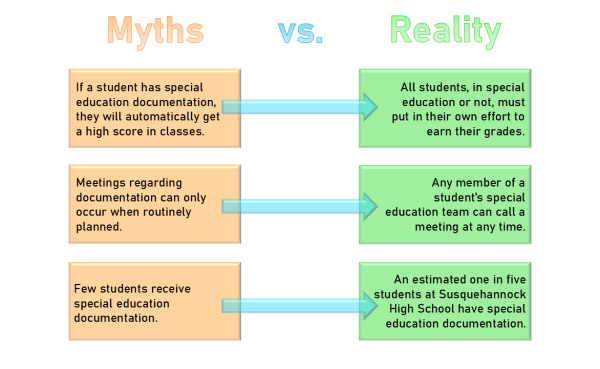
Whether evaluation is initiated by a staff member, a parent/guardian or a student, a team of required professionals will work together with the child’s family to go through the evaluation process. Starting at the age of 14, the student being evaluated or holding documentation is involved in meetings related to their special education.
“…you’ve got to get schedules to align and because they tend to happen during school hours, so it’s work hours for parents,” Sterner said. “So there’s all kinds of challenges there.”
Individualized Education Programs
Similarly to Section 504 plans, individualized education programs have the ability to provide students with accommodations in the classroom. Where these programs differ is in terms of modification and specialized instruction. Content within courses can be modified to meet students’ needs. Within each IEP, there are measurable goals that track student progress with their aids.
“I could teach them U.S. History, but it might not be at the same level that AP or general education is,” Rogers said. “It might be that I’m teaching them a little bit of what would be called modified or alternate curriculum.”
In other cases, specialized instruction may look like services provided outside of a student’s core classes. This is often used for students who have disabilities that are not easily remediated by a general education teacher, such as speech or motor skills development delays.
“The most common one we’ll have is for students who have speech and language disability… growth, especially with their mouth and their motors within their mouth and their language growth, impeded their ability to articulate or to say sounds properly,” Rogers said. “What we need to do is that when we have a specialized teacher, called a speech and language teacher, …[teach] that student how to say proper words and sounds appropriately. That becomes specially designed instruction. That teacher designs goals and provides specially designed instruction usually in the speech classroom, and it’s taken outside of or outside the general education classroom.”
Common Misconceptions